Appendix
Use the Appendix to review detailed file format requirements and state-specific notes for Stratus Allocator Pro.
Before processing a source file, make sure the file format, required fields, premium type codes, and state-specific requirements match the file you are uploading.
File Format
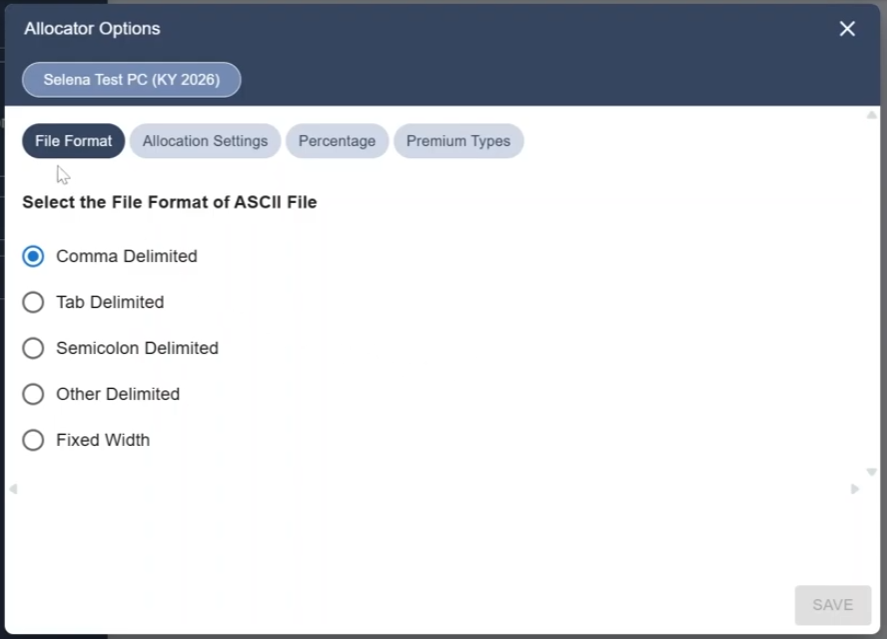
A file processed by Allocator can be in either delimited format or fixed width format.
The file format selected in Allocator Options must match the format of the source file.
Delimited Format
Delimited files use a character, such as a comma or tab, to separate each field in the file.
You may choose any supported delimiter to separate your data.
Each line in the file must end with a carriage return/line feed.
Negative numbers must be represented by a preceding or trailing negative sign.
If premium amounts include cents, the premium amount field should be formatted with a decimal between dollars and cents.
The maximum number of delimiters that can be included per line is 11, except for South Carolina.
The maximum number of delimiters that can be included per line in a South Carolina file is 15.
Delimited File Fields
The following fields may be included in a delimited source file:
Description | Maximum Length | Data Type |
Policy Number | 250 | Alphanumeric |
Premium Type | 250 | Alphanumeric |
Street Address | 250 | Alphanumeric |
City | 250 | Alphanumeric |
State Abbreviation | 2 | Alphanumeric |
Zip Code | 10 | Alphanumeric |
Premium Amount | 25 | Numeric |
Company Code* | 250 | Alphanumeric |
Miscellaneous 1* | 250 | Alphanumeric |
Miscellaneous 2* | 250 | Alphanumeric |
Miscellaneous 3* | 250 | Alphanumeric |
Miscellaneous 4* | 250 | Alphanumeric |
Agent’s Street Address** | 250 | Alphanumeric |
Agent’s City** | 250 | Alphanumeric |
Agent’s State** | 2 | Alphanumeric |
Agent’s Zip Code** | 10 | Alphanumeric |
The first seven fields are required.
Fields marked with * are optional fields.
Fields marked with ** are optional fields for South Carolina only. To include these fields, all preceding optional fields marked with * must also be included.
Fixed Width Format
Fixed width files use set character positions for each field.
Each line in the file must end with a carriage return/line feed.
Negative numbers must be represented by a preceding or trailing negative sign.
If premium amounts include cents, the premium amount field should be formatted with a decimal between dollars and cents.
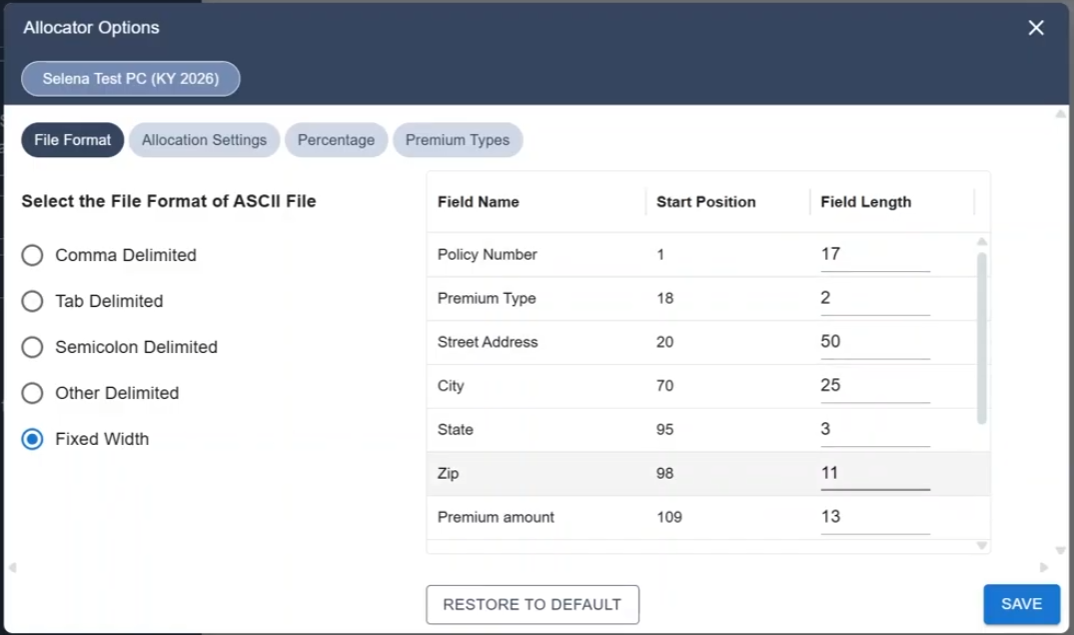
The field length includes a trailing blank space that must be included to separate each field.
Fixed width field lengths can be adjusted in Allocator Options when Fixed Width is selected.
Fixed Width File Fields
The following fields may be included in a fixed width source file:
Starting Column | Description | Length | Data Type |
1 | Policy Number | 17 | Alphanumeric |
18 | Premium Type | 2 | Alphanumeric |
20 | Street Address | 50 | Alphanumeric |
70 | City | 25 | Alphanumeric |
95 | State | 3 | Alphanumeric |
98 | Zip Code | 11 | Alphanumeric |
109 | Premium Amount | 13 | Numeric |
122 | Company Code* | 10 | Alphanumeric |
132 | Miscellaneous 1* | 25 | Alphanumeric |
157 | Miscellaneous 2* | 25 | Alphanumeric |
182 | Miscellaneous 3* | 25 | Alphanumeric |
207 | Miscellaneous 4* | 25 | Alphanumeric |
The first seven fields are required.
Fields marked with * are optional fields.
Optional South Carolina agent fields cannot be included in fixed width format. These fields can only be used with delimited file format.
The selected field length must include a trailing blank space. Adjusting the field length affects the starting position of each subsequent field.
State-Specific Notes
Each state may have specific requirements for the source file, premium type codes, or allocation results.
Review the applicable state section before processing a file for a new state or unfamiliar filing type.
Alabama
Alabama is used with the Municipal Tax product to file returns with individual municipalities and Avenu.
Alabama uses multiple premium type codes to distinguish between Fire and Marine and Other than Fire and Marine.
If the premium reported is considered fire, use premium type code F.
All other premium type codes are grouped into the non-fire category.
Delaware
Delaware is used with the Premium Tax product.
Delaware is designed to be used with the Delaware Annual Premium Tax Return Schedule WF T-5.
Property and Casualty premiums written are allocated to the City of Wilmington, New Castle County, Kent County, and Sussex County.
If premiums are allocated to 9998, a good matching address was not returned for the policy address and the premiums cannot be assigned to Wilmington or a county based on the source city.
Delaware does not require a breakout of premiums by type, so the Delaware module does not differentiate between premium type codes. Any code can be used.
Florida Firefighter’s and Police Pension Fund
Florida Firefighter’s and Police Pension Fund is used with the Premium Tax product.
This module allocates premiums covering risks within Florida to the correct Firefighter’s Pension district for taxation.
If the premium reported is considered fire, use premium type code F.
If the premium reported is considered casualty, use premium type code C.
If the premium type is a multiple-line premium, use premium type code X.
Georgia
Georgia is used with the Municipal Tax and Premium Tax products.
Georgia can be used with individual Municipal returns or the GID 17-A.
The Georgia municipal return does not require a breakout of premiums by type, so Georgia does not differentiate between premium type codes. Any code can be used.
Kentucky
Kentucky is used with the Municipal Tax product.
Kentucky includes an additional schedule called the County Allocation report to address the County Credit return that is generated for certain counties.
Kentucky groups allocated premiums into seven categories based on the premium type code included in the source file.
Kentucky premium type codes include:
- C = Casualty
- F = Fire and Allied Lines
- H = Accident and Health
- I = Inland Marine
- L = Life
- M = Motor Vehicle
- O = Other
Illinois Fire
Illinois Fire is used with the Municipal Tax product.
Illinois may be used to allocate premiums covering risks within Illinois to the correct municipality or fire district.
The Illinois Fire module does not differentiate between premium type codes in the source file and groups all allocated premiums together.
Louisiana
Louisiana is used with the Municipal Tax and Premium Tax products.
Louisiana can be used with individual Municipal returns and LaMATS returns in the Municipal product. It can also be used with the Premium Tax 1976 return.
Louisiana premiums are taxable. If premiums are not allocated within the limits of a taxing municipality, the premiums are taxable by the parish.
Louisiana does not differentiate between premium type codes in the source file and groups all allocated premiums together.
New York Fire Protection Districts
New York Fire Protection Districts is used with the Municipal Tax product.
This module allocates premiums covering risks within New York to the correct Fire Protection District for taxation.
New York Fire does not use municipal boundary maps to determine where a policy should be allocated. It uses the database supplied by the New York Department of Financial Services.
Data can be exported to New York State Fire Tax Distribution and Premium Pro Municipal.
New York Metropolitan Transportation Authority
New York Metropolitan Transportation Authority, or New York MTA, is used with the Premium Tax product.
This module allocates premiums covering risks within New York to the correct county.
The New York MTA Surcharge applies to all types of premiums written within the Metropolitan Commuter Transportation District, so this module does not differentiate between premium type codes.
Premiums allocated to the following counties are included in the total MTA Surcharge amount:
- Bronx County
- Dutchess County
- Kings County
- Nassau County
- New York County
- Orange County
- Putnam County
- Queens County
- Richmond County
- Rockland County
- Suffolk County
- Westchester County
All other premiums are excluded from the total MTA Surcharge amount.
North Dakota
North Dakota Fire is used with the Municipal Tax product.
North Dakota Fire may be used to allocate premiums covering risks within North Dakota to the correct municipality or fire district.
The North Dakota return does not require a breakout of premiums by type, so this module does not differentiate between premium type codes and groups all allocated premiums together.
South Carolina
South Carolina is used with the Municipal and Premium Tax products.
South Carolina is used with the MASC return in the Municipal product and the Property and Casualty Premium Tax return.
South Carolina has an additional report called the Fire Premiums Summary report, which can be used to complete Schedule 08 of the premium tax return.
South Carolina does not distinguish between premium type codes in the source file and groups all allocated premiums together.
The South Carolina delimited file format may include optional agent address fields:
- Agent’s Street Address
- Agent’s City
- Agent’s State
- Agent’s Zip Code
When filing the MASC return, give preference to the policy risk address first. If the policy risk address is non-taxable, MASC requests that you perform a second allocation using the agent’s address.
Related Articles